Passive Systems
Earth Tubes and Ground Heat Storage
How earth tubes temper incoming air and how a ground store holds summer heat for winter, with the design rules that keep both working.
Why soil is a good store
Soil has a large mass and conducts heat poorly. Together these mean temperature changes penetrate slowly. A few metres down, the temperature stays close to the annual average of the air all year, delayed by a few weeks. Used deliberately, this natural buffer can store heat when it is abundant and release it when it is scarce. What matters is that the heat does not leak away but stays within a defined volume. That is why the store is insulated, usually at the top and the sides, where the loss would be greatest. Without that insulation the heat would simply spread into the surrounding ground.
How the store is built
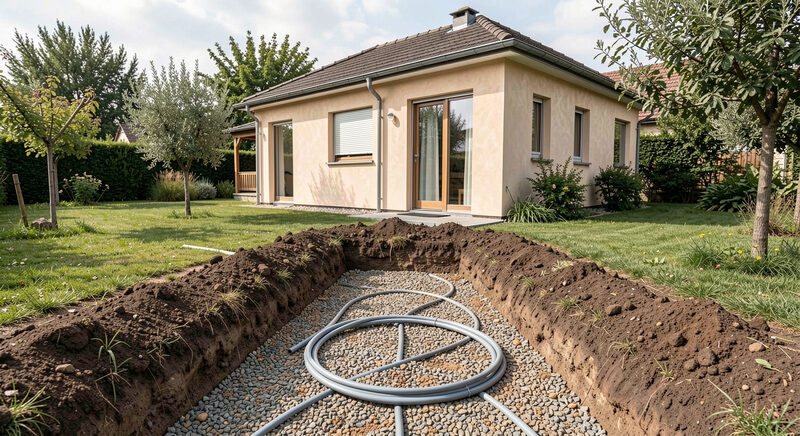
A ground store is a large body of material crossed by pipes. It can be natural soil threaded with a grid of pipes, or a made body of gravel and concrete. On site, insulation is laid first, then the pipe system, then the material. The pipes run to a manifold that connects them to the wall, the roof and the ventilation. It matters that the pipes are evenly spread, so heat does not linger in one spot. The build-up resembles underfloor heating, except that it lies below the building rather than inside it.
Earth tubes and the supply air
Earth tubes are the simpler cousin of the ground store. Here the incoming ventilation air itself is routed through pipes buried in the ground, so it arrives tempered. In winter the soil warms the cold air, in summer it cools the warm air. The tubes are usually laid at a shallow depth and need care: they must be sealed against water and radon, and their inner surface must stay clean, because a damp or dirty tube becomes a source of odour. Well designed, earth tubes deliver fresh air at a mild temperature with no energy input beyond the fan.
Charging in summer
In summer the roof collects heat. Surfaces already exposed to the sun become collectors, with pipes lying between the roof covering and the insulation. The fluid warms up and carries the heat into the ground store. There it releases the heat and cools down, ready to climb to the roof again. Over the warm months the store fills. Some of the heat is lost, because no store is perfectly sealed. The loss depends on the insulation, the size and the temperature. Choose the store large enough and there is still enough heat in winter.
Discharging in winter
When the outside air turns cold, the direction reverses. The fluid flows through the store, takes up its heat and carries it to the thermal barrier in the wall and to the ventilation. The wall gives the heat to the rooms, the ventilation warms the fresh air. Because flow temperatures stay low, the stored heat covers much of the winter. In very cold spells a small backup heater or a stove can close the gap. How the wall distributes that heat is covered in the article on the thermal barrier.
Sizing and losses
The size of the store follows the demand. A house with low heat demand needs less volume than an uninsulated building. Plan the store too small and there is not enough heat in winter. Build it too large and money and space are wasted. Besides size, temperature matters: a store heated strongly loses more than one held at a moderate level. That is why passive systems work with moderate temperatures and large areas rather than hot, small stores. A careful heat load calculation is the basis for that sizing, see heat load calculation.
Limits and site questions
A ground store needs space and a suitable plot. Where the water table is high or the soil is weak, the build becomes difficult. Geology matters too, because different soils conduct and store heat differently. In dense urban sites there is often no room beside the house, leaving only the area under the building. Checking these conditions early avoids late surprises. Ignoring them means planning a store that is never built. For retrofits with no room in the ground, ventilation and envelope remain the first levers, as described in the section on retrofit and insulation.
Maintenance and value
A ground store is low maintenance but not maintenance free. The pipes must stay sealed, so no water escapes and no soil softens. The pump and valves need occasional checks, and the controls should be reviewed once a year. If the store is not charged properly in summer, the heat is missing in winter, and the fault only shows months later. A look at the charge balance therefore belongs to the annual routine. Over the years the running cost is low, because the heat comes from sun and soil and no fuel is burned. Whether the investment pays back depends on energy prices, building size and how long it is used.
The key points in short
Soil stores heat because it is heavy and conducts poorly. A ground store keeps solar heat for months and returns it in winter, provided it is insulated. Earth tubes are the simpler version, tempering ventilation air as it passes through buried pipes. Charging happens in summer, discharging in winter. Size follows demand, and moderate temperatures lose less than hot ones. The store needs space and a suitable plot, and it needs a short annual check to keep working.