Passive Systems
Solar Roofs as Collectors
How a roof can act as a large solar collector, how the heat is carried to a ground store and how that differs from solar panels for power.
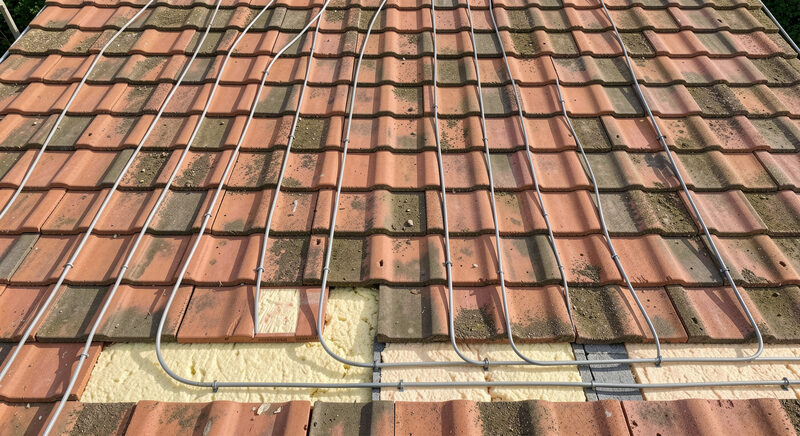
The roof as a collector
A solar roof uses the whole roof surface as a collector, not a small panel on part of it. Pipes run between the roof covering and the insulation, across as much of the area as possible. When the sun shines, the fluid in the pipes warms up. Because the area is large, even diffuse light is captured, and the roof does not need to face exactly south to work. The heat is then carried down to a ground store. The principle is simple, but the detailing matters: the pipes must lie close to the covering to catch the heat, and the insulation below must stop it entering the house in summer.
How it differs from solar panels
Solar panels that generate electricity, known as photovoltaic panels, turn sunlight into power. A solar roof as described here collects heat, not power. The two can be combined, with panels above and pipes below, but they are different jobs. A thermal roof feeds a store that heats the building in winter; a photovoltaic roof feeds the grid or a battery. For a passively climatised house the thermal roof is the more useful part, because the heat can be stored for months in the ground, whereas electricity needs batteries or a grid connection. Many designs use both, each doing what it does best.
Air collectors and water collectors
Thermal collectors come in two broad kinds. Water collectors circulate a fluid through pipes, as in a solar roof, and can reach useful temperatures for a store. Air collectors heat air directly, often in a gap behind a dark surface, and are simpler and cheaper but deliver lower temperatures. A solar roof is usually a water collector, because the fluid can be pumped to a distant store with little loss. Air collectors suit smaller jobs, such as pre-heating ventilation air or drying. The choice follows the size of the store and the temperature it needs.
Charging the ground store
The heat gathered on the roof is not used at once. It is sent to the ground store, where it is released and held for months. The fluid cools as it gives up its heat, then returns to the roof to be warmed again. This loop runs through the summer, gradually filling the store. The rate depends on the sun, the roof area and the store temperature: as the store warms, it accepts heat more slowly. A well matched system fills the store by the end of summer and draws on it through the winter. How the store is built is covered in the article on earth tubes and ground heat storage.
Design and orientation
The roof area, its slope and its orientation all affect how much heat is collected. A large roof facing the sun gives the most, but even a roof split between two directions can work, because the store accepts heat over a long season. The pipes must be sized so the pump does not work too hard, and the roof must be insulated below to keep the heat from entering the house in summer. Overheating is a real risk: a roof collector that cannot get rid of its heat can stagnate. A store large enough to absorb the summer surplus avoids that problem.
Cost and practical limits
A solar roof costs more than a plain roof, because of the pipes, the manifold and the controls. It makes most sense when the roof is being built or replaced, so the extra work is done once. Retrofitting a collector into an existing roof is possible but disruptive. The economics depend on the store size and the energy prices: a system with a large store and low demand pays back best. In cloudy regions the yield is lower, and the store must be sized accordingly. A thermal roof is not a stand-alone solution but part of the envelope, store and ventilation system.
Keeping it working
Like any collector, a solar roof needs some care. The fluid must not freeze in winter, so it carries antifreeze, and the pressure should be checked. The pipes must stay sealed, and the pump and controls need occasional attention. If the system stagnates in a hot summer, the fluid can degrade, so a way to dump excess heat is useful. These points are simple but easily forgotten once the roof is out of sight. A short annual check keeps the collector working for decades and protects the investment.
How it fits the whole system
The solar roof is one of four parts that work together: the collector, the ground store, the wall and the ventilation. On its own it only gathers heat; the store holds it, the wall distributes it and the ventilation brings in fresh air. A design that treats the roof as a separate gadget misses the point. Seen as part of the system, the roof is the entry point for the energy that keeps the building comfortable through the year. The related components are described in the section on passive systems.