Passive Systems
The Thermal Barrier in an Exterior Wall
What a thermal barrier does inside an exterior wall, how it cuts heat loss and why it can work without a heat pump.
What a thermal barrier is
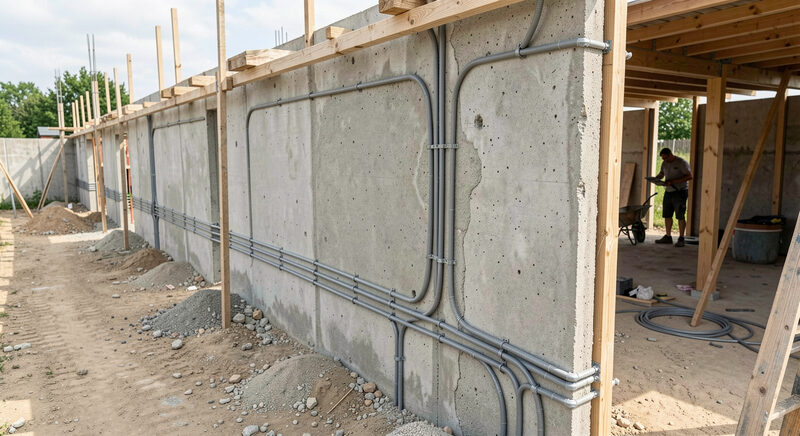
A thermal barrier is a thin, water-bearing layer inside the external wall, usually between the insulation and the structural element. A fluid circulates through the pipes at a temperature only slightly above or below the desired room temperature. The wall gives that warmth to the room or takes warmth from it, depending on the season. The name comes from the fact that the layer absorbs the temperature jump between outside and inside. Instead of a cold internal surface where moisture condenses, the wall holds a mild temperature. The build-up resembles underfloor heating, except that it stands upright and runs at very low flow temperatures.
How the build-up looks
From outside in, the layers are usually a weather skin, insulation, the pipe layer and the structural element, often concrete or masonry. The pipes are small in diameter, because heat is delivered over a large area rather than a small heating surface. They are laid in loops and connected to a manifold inside the house. It is essential that the pipes are fully encased in material, so they couple well to the wall. A poorly embedded pipe gives its heat to an air gap and loses its effect. On site the pipe layer must therefore be fixed carefully before the concrete is poured or the render applied. Insulation thickness and pipe position together decide how much heat reaches the room and how much escapes outside.
Why low temperatures are enough
Because the wall surface is large, a small temperature difference is enough to heat a room. A conventional radiator needs hot water, a thermal barrier runs on lukewarm water. That has two advantages. First, it suits heat sources that cannot deliver high temperatures, such as a ground store or a solar collector. Second, there is no dust being stirred up and no dry air, because the heat arrives as radiation from a large surface. In summer the same circuit can cool, by sending cooler water through the pipes. The wall then takes heat out of the room without an air conditioner running. The condition is that the flow temperature stays just above the dew point, so no condensation forms.
What it can and cannot do
The thermal barrier cuts the heat loss of the wall and spreads warmth evenly. It does not replace insulation. Without good insulation the heat would flow outside before reaching the room. The barrier supplements insulation, it does not substitute for it. Nor can it turn an uninsulated old house into a passive house overnight. To judge the effect, the wall must be seen as a whole, with its U-value, insulation thickness and pipe position. The article on insulation materials shows how the insulation fits with it.
Design and common mistakes
The biggest mistakes happen on site. Pipes are laid too far apart, leaving cold strips. Junctions at windows and ceilings are forgotten, leaving thermal bridges. The manifold is chosen so that pressure loss is too high and some loops are barely supplied. Controls are another source of error: set the flow temperature too high and the wall responds slowly and overheats the room. Anyone designing a thermal barrier should match it to a heat load calculation, so the area fits the load. The basics are in the article on heat load calculation.
Operation and controls
In operation the wall behaves slowly. It reacts over hours, not minutes, and that is intended. Controls should therefore work with long time windows and not try to correct every temperature swing at once. Treat the system like a conventional boiler and you will be disappointed, because the wall cannot follow quickly. Give it time and it delivers an even climate. The same applies to summer cooling: the wall takes heat out of the room slowly and evenly, without draughts. What matters is a control that monitors the dew point and limits the flow temperature.
Cost and value
A thermal barrier costs money, mainly through the pipes, the manifold and the careful embedding. In new build the effort is modest, because the wall is being built anyway. In a retrofit it is higher, because the wall must be opened or the facade renewed. Against that stand low running costs, because the wall works at low temperatures and needs no heating surfaces in the rooms. Over the years the investment can pay back, especially when a heat pump or a ground store supplies the heat. Weigh the cost of the whole wall, not just the pipe layer.
When the effort pays off
The thermal barrier is most economical in new build, because the pipes can be built into the wall from the start. In a retrofit the later installation is demanding, unless the facade is being renewed anyway. Anyone renovating a house and insulating the external wall can fit the pipe layer in the same job. In both cases the point holds: the thermal barrier is not an end in itself but one block of a system of envelope, store and ventilation. Seen in isolation it disappoints. Placed in that system it brings comfort and saves heating energy.