Retrofit and Insulation
Insulation Materials Compared
Mineral wool, wood fibre, cellulose and rigid foams compared on conductivity, moisture, fire and where each one belongs in a retrofit.
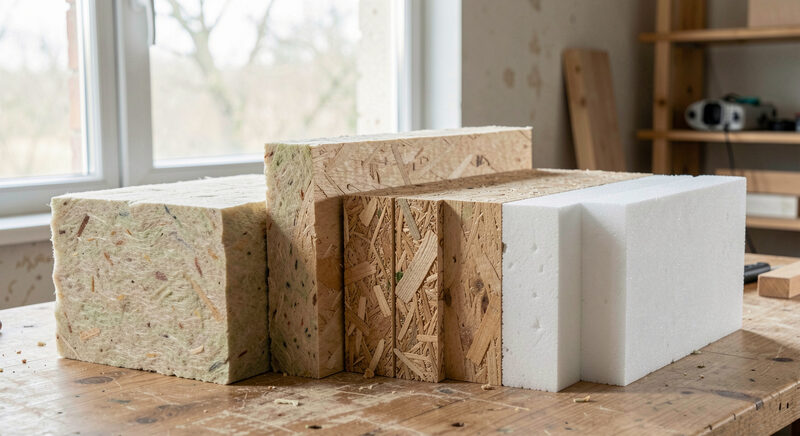
What matters in an insulation material
The key figure is thermal conductivity, given as a lambda value. The lower it is, the better the insulation for a given thickness. Beyond that come moisture behaviour, fire performance, compressive strength and price. A material with an excellent lambda value can be unsuitable in a damp construction. The choice therefore belongs to planning, not to the shopping trolley. Reading the figures honestly is the first step to a sound decision.
Mineral wool
Mineral wool, made from glass or stone, is the classic insulation. It is non-combustible, vapour-open and inexpensive. It is easy to fit in walls, roofs and floors. Its weakness is moisture: once wet it loses part of its insulating value, and the moisture must be able to escape. It therefore needs a correct construction, with a ventilated cavity or a vapour control layer. For many standard jobs it remains the most economical choice.
Wood fibre and cellulose
Wood fibre and cellulose are renewable insulations. They insulate well, take up moisture and release it again, which is an advantage in timber buildings. Cellulose is blown in as loose material, wood fibre comes as boards or mats. Both are vapour-open and suit projects with an ecological aim. Their drawback is price and, for cellulose, the need for careful blowing so no voids remain. In internal insulation they play to their strengths, because they buffer moisture rather than trap it.
Rigid foams
Foams based on polystyrene or polyurethane have very low lambda values and insulate well at little thickness. That makes them useful where space is tight, such as under a screed or in narrow cavities. Against that, they are less vapour-open and, depending on type, more combustible than mineral wool. They work well in an external system with a ventilated cladding, but are risky in a damp construction. Anyone using them should check fire rules and vapour movement first.
Material and construction together
No insulation is right everywhere. In an external wall with a rendered system, boards with enough compressive strength work well. In a ventilated facade the material may be vapour-open, because moisture is carried away. In internal insulation, capillary-active materials are needed, able to take up and release moisture. Respect these rules and building damage is avoided. Ignore them and mould behind the insulation is the risk. The systems for the wall are set out in the article on retrofit and insulation.
Fire and disposal
Fire performance matters especially in multi-storey buildings. Mineral wool and some foams are non-combustible or flame-retardant, while others burn and produce smoke. The rules depend on the building type and height. Disposal counts too: some materials can be recycled, others cannot. Anyone planning for the long term includes these points. They help decide how sustainable a retrofit really is, beyond the headline lambda value.
A practical way to decide
For most retrofits the choice comes down to a few questions. Is the construction vapour-open or sealed? Is there room for thick insulation, or does every centimetre count? Are there fire or heritage requirements? Is an ecological material wanted? The answers narrow the field. Compare local prices and check the figures, and a sound decision follows. The wider context is in the section on retrofit and insulation.
Reading the numbers
Three figures decide a material's suitability. The lambda value describes conductivity and so the insulating effect. Density tells how heavy the material is, which matters for compressive strength and sound. The water absorption coefficient shows how much moisture it takes up. Comparing these values allows an honest judgement, instead of relying on marketing. A low lambda value alone is not enough if the material sits in a damp construction and loses its effect there.
Common mistakes
The most common mistake is choosing on price alone. A cheap material in the wrong construction causes costs later that outweigh the saving. A second mistake is ignoring vapour movement: fit a vapour-open material behind a sealed layer and moisture cannot escape. A third is checking fire requirements only after installation. Settle these points before ordering and you save rework and trouble.
Where each material belongs
External walls suit boards with enough compressive strength to carry a render or a cladding. Roofs favour light materials with good insulation at limited depth, so mineral wool or foam is common there. Ground floors need boards that resist pressure and take up little moisture. For cavities and irregular spaces, blown cellulose is practical because it fills the shape. Choose the material to suit the location and voids and damp are avoided. An overview of the systems is in the article on retrofit and insulation.
Thickness, performance and space
How thick the insulation must be depends on the target and the material. A material with a low lambda value reaches the same performance with less thickness, which matters where space is limited. But thin, high-performance boards usually cost more and are less vapour-open, so the saving in space can bring a moisture risk. Where room allows, a thicker layer of a simpler material is often the sounder choice. The right balance depends on the element, the target standard and the budget, and it is worth working out before ordering.